
What is the Moving Social Work Programme?
Moving Social Work (MSW) is an evidence-based education programme designed to encourage and support social workers to have conversations about physical activity with Disabled people and other groups accessing social care.
The programme has been co-produced with a wide range of partners, including Social Work England, Disability Rights UK, social workers, Disabled people, NHS organisations, and leaders across local authorities.
Moving Social Work is embedded within the UK Government Disability Strategy (2021) and is recognised by the Department of Health and Social Care as part of the Government Strategy for Physical Activity (2023–2027) as an important opportunity to tackle health inequalities.
The programme aims to increase the knowledge, skills, and confidence of social workers so they can safely and effectively promote physical activity as part of strengths-based and person-centred practice.
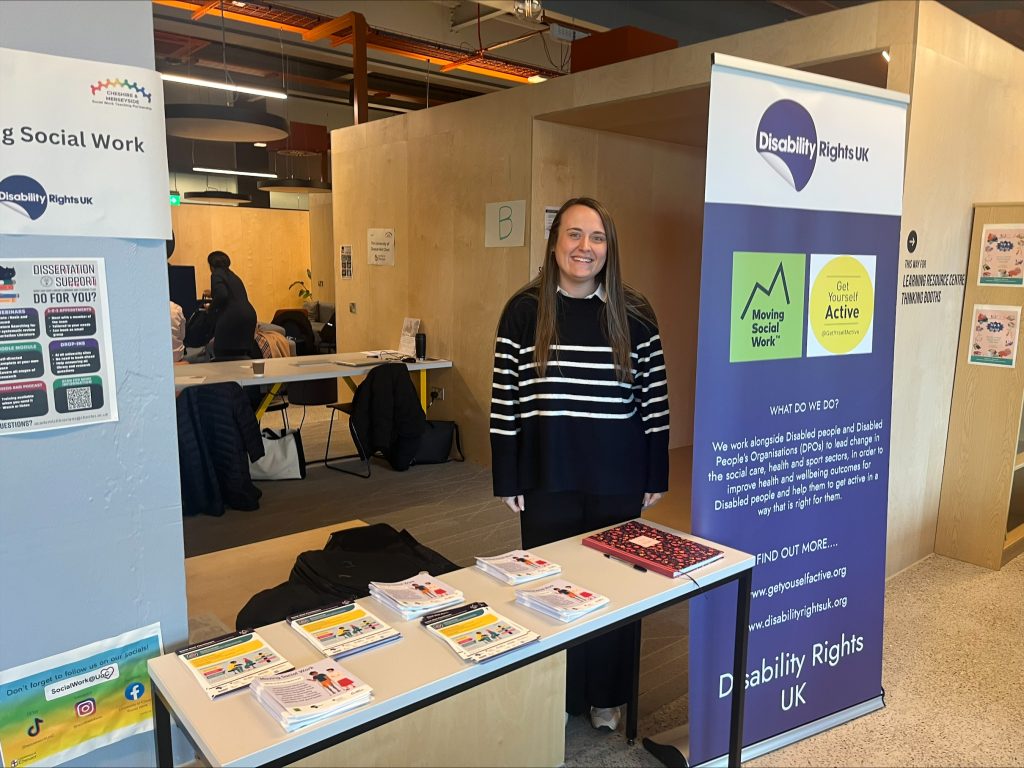
Why does Moving Social Work matter?
Research shows that social workers are highly trusted professionals and that Disabled people would welcome conversations about physical activity as part of social work support.
Physical activity can play an important role in:
- Improving wellbeing and mental health
- Reducing loneliness and social isolation
- Supporting independence and community involvement
- Tackling wider health inequalities
- Supporting positive outcomes linked to the Care Act
- Improving overall quality of life
Importantly, physical activity is not limited to sport or structured exercise. Everyday movement such as gardening, walking to the shops, household tasks, or getting up regularly throughout the day can all positively contribute to wellbeing.
Research completed during Phase 1 of the programme identified a clear need to improve social workers’ confidence, skills, and understanding around physical activity conversations. The MSW training programme was developed to respond directly to this need.
The training has since been rigorously tested and evaluated, with both quantitative and qualitative findings demonstrating positive impact.
“I didn’t think this was for me. But the training is really important because it fits what we do and moves our profession forward in really positive ways. Promoting physical activity is not something I thought about but is definitely something I will be doing from now.”
Social Work Participant
Details about Phase 1, Phase 2 and Phase 3
Phase 1 – Research, discovery and development
Phase 1 focused on building the evidence base for the programme and understanding the role social workers can play in promoting physical activity.
Key activities included:
-
- Conducting research with social workers, Disabled people, and sector leaders
- Identifying barriers, opportunities, and training needs
- Exploring how physical activity aligns with social work values and practice
- Co-producing programme content with partners and stakeholders
- Designing and testing the initial training offer
This phase established the foundations of the programme and highlighted the need to improve social workers’ knowledge, skills, and confidence around physical activity.
Phase 2 – Training delivery and Evaluation
Phase 2 focused on delivering the training programme and evaluating its impact across the sector.
Key activities included:
-
- Delivering evidence-based training sessions to social workers and social care professionals
- Providing practical guidance on how to discuss physical activity safely and confidently
- Supporting practitioners to embed physical activity into care planning and everyday conversations
- Evaluating participant experiences, learning outcomes, and behavioural change
- Gathering qualitative and quantitative evidence to strengthen the programme
The evaluation demonstrated that the programme positively improved participants’ confidence and understanding of how physical activity supports wellbeing and social care outcomes.
Phase 3 – Embedding and future growth
Phase 3 focuses on embedding Moving Social Work into wider professional practice, workforce development, and social care systems.
Current and future priorities include:
-
- Expanding access to the training programme
- Embedding physical activity conversations into everyday social work practice
- Strengthening partnerships across health, social care, and community sectors
- Supporting universities and workforce development pathways
- Continuing research, evaluation, and programme improvement
- Exploring opportunities for national scale and long-term sustainability
The long-term vision is for physical activity and wellbeing conversations to become a recognised and routine part of strengths-based social work practice.
What does the training cover?
The training explores:
- Why social workers are well placed to promote physical activity
- The latest evidence and understanding around physical activity and movement
- The benefits of movement for wellbeing, mental health, and social outcomes
- The risks of inactivity for Disabled people and others accessing social care
- Practical and safe ways to discuss and encourage movement
- How physical activity can be incorporated into care planning and strengths-based practice
- Real-life examples, scenarios, and practical approaches for everyday social work settings
The training recognises that physical activity looks different for everyone and focuses on achievable, meaningful movement that works for individuals.
Key stats on the programme
The Moving Social Work Programme has continued to grow significantly across England, demonstrating strong engagement from social workers, universities, and sector partners.
Training and Reach (to Dec 2025)
- 132 CPD training sessions delivered to practicing social workers and social care professionals
- 2,713 practitioners trained through Continuing Professional Development (CPD) sessions
- 32 university training sessions delivered to student social workers
- 755 student social workers engaged across universities and teaching partnerships
- Training delivered or scheduled across 34 universities in England
- Engagement with 49% of universities delivering Social Work England-approved programmes
Research and evaluation
The programme is supported by a growing evidence base through multiple interconnected research streams, including:
- Interprofessional working in health and social care
- Intersectionality and physical activity
- Conversational analysis and communication tools
- Social Work Physical Activity Champions
- Social worker wellbeing and movement
Evaluation findings consistently demonstrate increased practitioner:
- Knowledge and understanding of physical activity
- Confidence in discussing movement and wellbeing
- Ability to incorporate physical activity into care planning
- Understanding of physical activity as a social justice and rights-based issue
Co-production and lived experience
Co-production remains central to the programme. Disabled people, carers, social workers, academics, and practitioners continue to shape the programme’s design, resources, research, and strategic direction.
The co-production approach helps ensure that programme outputs are:
- Grounded in lived experience
- Accessible and inclusive
- Relevant to practice realities
- Focused on rights, wellbeing, and meaningful participation
Where are things going...?
The Moving Social Work Programme will continue to evolve through collaboration, research, and ongoing engagement with the social work sector.
Future developments may include:
- Wider rollout of the training programme
- Increased collaboration with local authorities, universities, and health partners
- Further development of resources and learning materials
- Continued research into impact and outcomes
- Embedding physical activity more strongly within social work education and practice standards
- Supporting national conversations around prevention, wellbeing, and health inequalities
By supporting social workers to promote movement and wellbeing, the programme aims to improve outcomes for Disabled people, strengthen communities, and contribute to a healthier and more inclusive society.


Strategic Partnerships
The programme works collaboratively with a wide range of national and local partners, including:
- Social Work England
- Disability Rights UK
- Durham University
- Sport England
- British Association of Social Workers (BASW)
- Skills for Care
- Social Care Institute for Excellence (SCIE)
- Active Partnerships
- Local authorities, Disabled People’s Organisations, universities, and NHS partners
Latest resources
Our stories
-
Social care training proves a successSocial care training proves a success
This news update details the social care training we launched in partnership with SPECTRUM Centre for Independent Living.
-
Emily’s storyEmily’s story
In this blog, we spoke to Emily from Sense in Rotherham to learn how she and her team have used the Get Yourself Active Social Care Activity pack to support Disabled people to get active.
-
Get Yourself Active launches new Social Care Activity packGet Yourself Active launches new Social Care Activity pack
This story is about the launch of a new resource for social care workers to help them support Disabled people to be active.
